
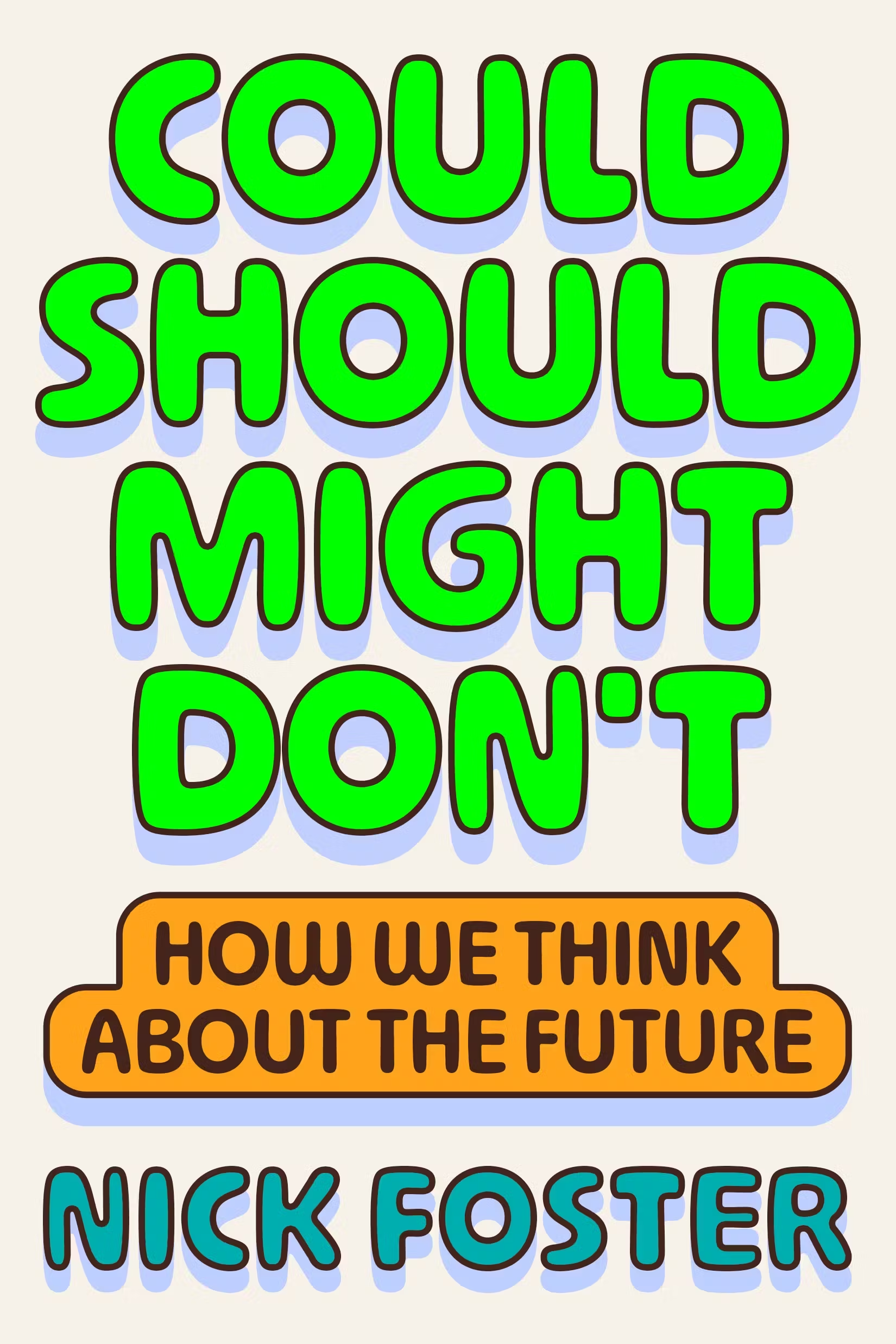
Disclosure: A digital review copy of Could, Should, Might, Don’t was provided by Farrar, Straus and Giroux.
This is how I spend my slow hours at work: I put on videos of AI-generated “futuristic ambience” showing spaceship interiors that look suspiciously like luxury resorts, complete with reclining beach chairs and a giant planet hovering majestically in the background. And as I sit there, physically filling spreadsheets, my mind has admittedly never left the vicinity of the spaceship. I’m absolutely obsessed with the future. What Nick Foster’s Could, Should, Might, Don’t helped me realize, however, is that while we live in an age obsessed with the future, we are actually remarkably bad at thinking about it.
What I had just told you, for instance, falls into the “fallacy” of Could futurism—a mode of thinking about the future that fixates on what’s technologically possible, mirroring Silicon Valley’s glossy optimism while ignoring cost, friction, and consequence. Nick Foster, who once led the design department at Google X, identifies four modes of thinking in total: Could, Should, Might, and Don’t—which also happen to form the book’s title. Foster argues that none of these frames is wrong by itself; the problem is living inside just one of them. Real foresight, he suggests, requires holding all four at once.
This book is essentially a critique of how we think about the future, which is why it is written in a tone of skepticism that lands a punch in the gut and forces us to wake up to the fact that we are doing it wrong. Take his coined term, the “future mundane”—the idea that the future isn’t all about high-budget sci-fi visions populated by flying cars and helpful humanoid robots. Instead, it is made of boring, stubborn, unglamorous details: failing to pay digitally because the signal and Wi-Fi are dead, the waste problem of products that weren’t designed to last, or the frustration of trying to turn down the AC when the screen inside a car freezes—essentially, the same human plight, just with more expensive hardware.
I believe the book’s most important critique is the stagnation of our collective imagination of the future. Rather than inventing new visions, we recycle old ones—especially those inherited from the late 1970s and 1980s. Search for the word “futuristic” today and you still get glowing blue lights, sleek white surfaces, aggressive geometry. We are not imagining the future so much as reenacting the past—what Foster memorably calls a regurgitated future.
I gleefully pick the Tesla Cybertruck as the poster child of this regurgitation. Marketed as radical, rebellious, and forward-looking, it is essentially an EV pickup draped in 1980s cyberpunk aesthetics—low-poly surfaces, dystopian minimalism, and Syd Mead–era sci-fi. It looks more like a tribute to 80s futurism than a truly futuristic object; it is perceived as “futuristic” largely because it is aggressively marketed (from the bottomless pockets of a billionaire, no less) and, more importantly, because we grew up with movies that taught us what the future was supposed to look like. Meanwhile, its design thinking has proven questionable, as more and more flaws surface online from users (sharp edges, stainless-steel bodies prone to rust).
The same recycling appears in humanoid robots, flying cars, and frictionless holographic interfaces. This is the real problem: when we mistake familiar sci-fi props designed to impress for progress, we risk ignoring solutions that look ordinary but work better—much like most solutions in real life. We see this most clearly in education, where the once-heroic promise that every classroom would be equipped with sleek, lightweight tablets is being dismantled by reality. Countries like Sweden, once at the vanguard of the digital revolution, are stepping back from screens and returning to physical books. They have discovered that while a tablet could hold a thousand books, the mundane human brain often learns better by flipping a physical page. It is humbling to admit that sometimes the most “futuristic” move is recognizing that an old solution was better all along.
As someone who has worked in a startup before, “Might” thinking is a slap in the face. This is the domain of forecasts, spreadsheets, and probabilistic confidence—where something seemingly rational can become insidious. Foster suggests that data often serves less as a tool for discovery than as a veneer of inevitability for conclusions someone already wants. Of course, anyone who earns a living from presentations instinctively understands that numbers are rarely neutral; what we often miss are the consequences. He illustrates this through figures like Paul Ehrlich, whose 1968 book The Population Bomb confidently predicted mass global starvation by the 1970s. Ehrlich’s mistake was not bad math, but linear thinking. He projected existing trends forward without accounting for unexpected innovation, human adaptation, or the messy reality of agricultural life. The Green Revolution didn’t just disrupt his forecast; it made it irrelevant. Foster calls this error “numeric fiction”: the belief that specificity equals truth. A forecast with decimal points feels more trustworthy than uncertainty, even when both are guesses. Data, he cleverly argues, often functions like a mirror—it reflects the biases of those who collect and frame it.
Ultimately, you won’t find answers in Could, Should, Might, Don’t. It offers not so much a prediction of what will happen as a tool for thinking more responsibly about the future. This is why the book feels especially urgent now. For much of history, imagining the future was a form of escapism; today, it is unavoidable. Climate change, artificial intelligence, gene editing, and space exploration are no longer sci-fi possibilities—they are active forces shaping our world. Moreover, we have already borrowed heavily from the future, and there is no guarantee it will look like the one we were promised, or even that it will still be there when we are finally able to repay it.
I appreciate the book’s dispelling quality. It strips the future of wishful thinking and returns it to the realm of responsibility, trade-offs, and real human experience. Like Thinking, Fast and Slow or The Art of Thinking Clearly, it changes not what you think, but how you think—you can’t unsee it. I finished the book with a sense of shame. I’d spent so much time staring at those luxury spaceships—convinced I was a visionary—that I’d forgotten how to actually think. Foster’s achievement isn’t telling us what the future is; it’s reminding us that we aren’t nearly as smart as we think we are.