
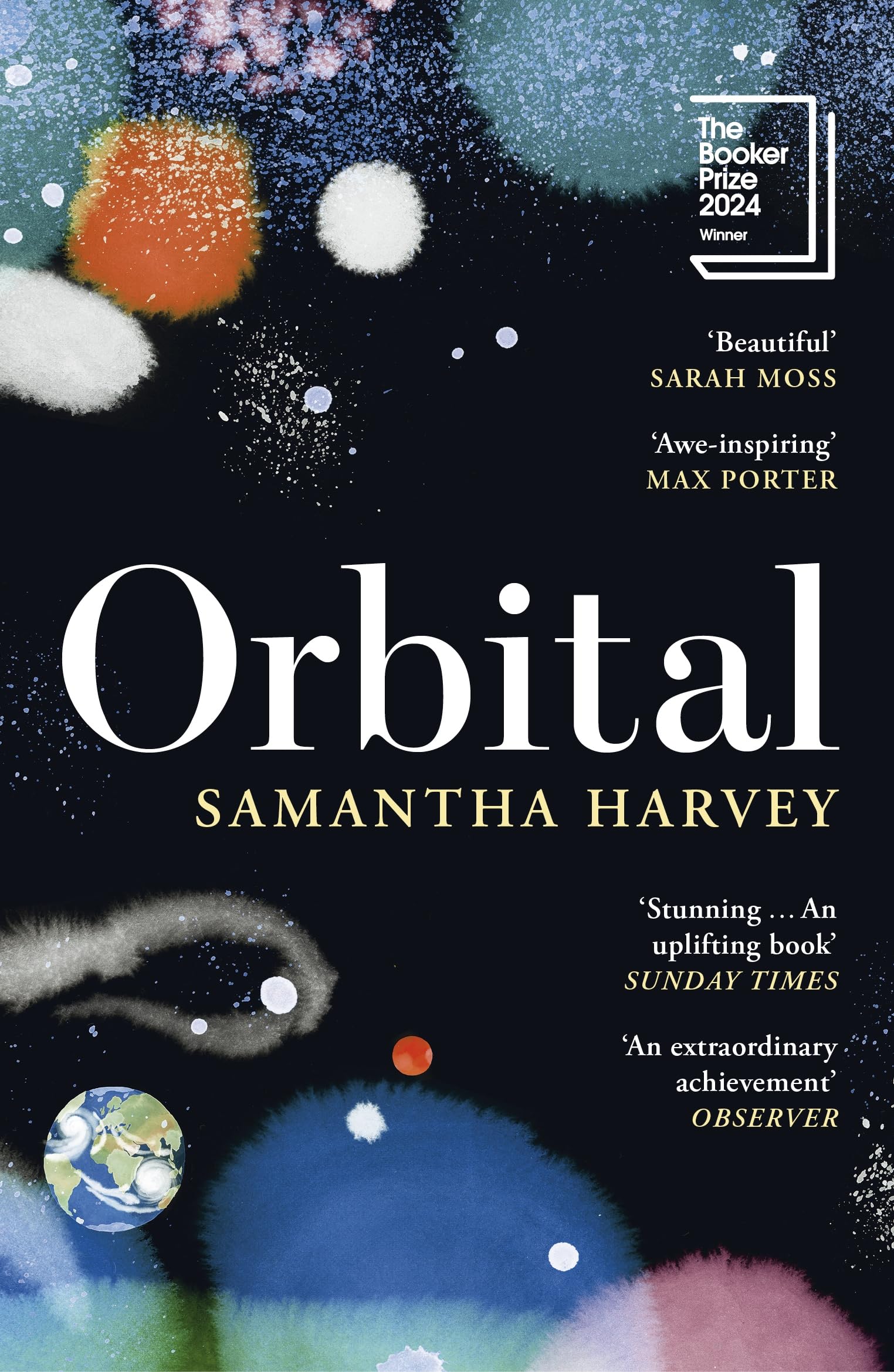
On Orbital, Space, and the Absence of Discovery
For a space enthusiast who is also interested in philosophy, Orbital should be my kind of novel. From its premise, it is depicted as a quiet, reflective work, and from the length of the book, a restrained one. To seal the deal, it also won the Man Booker Prize.
Set aboard the International Space Station, Orbital presents astronauts circling Earth, observing its beauty, fragility, and continuity. The novel is lyrical and carefully composed, but halfway through it becomes clear that space here is not a mysterious force that pressures thought and action. Instead, it functions as a platform from which conclusions are drawn. The astronauts are frequently described as awed—collectively, repeatedly—yet each return to awe yields no new development, no altered understanding. Wonder does not accumulate here; it simply affirms, again and again, what we already know.
The book often gestures toward the personal histories and unresolved problems of each individual back on Earth. These problems are acknowledged almost as a matter of record, then held at a safe distance. They do not interfere with perception, task, or desire. The astronauts sometimes long for Earth, but then reiterate that if they were asked to go back, they would not. This back and forth never satisfyingly sharpens into contradiction or decision. The result is a peculiar emotional suspension: conflict is named, then neutralized. The novel, like the ISS itself, remains curiously weightless—circling, observing, but never quite entering gravitational pull.
Orbital establishes conditions of extremity—alienation, distance, repetition—but refuses to let those conditions contort interior life. The astronauts, frustratingly, do not discover anything fundamentally new about themselves; they recollect what they already know, only from a different vantage point. Reflection precedes experience rather than arising from it. With everything space has to offer, this feels like a huge missed opportunity.
The language is polished and often beautiful (“Raw space is a panther, feral and primal”), but more often than not, the prose leans toward abstraction (“…only the immense consolation of that which they could never fathom or comprehend”). We are told that the view is consoling, immense, unfathomable—a choice of words that supplies emotional resolution in advance. And yet again, unfathomability here is consoling not destabilizing. Instead of allowing perception to struggle toward sense, the novel delivers interpretation pre-made, fully formed. Repetition—of orbits, of observations, of shared awe—becomes ritualistic, not developmental.
The use of a collective narrative voice reinforces this flattening. Often, individual differences within the crew are flattened into a single sensibility. The writer chooses to let space dissolve these various personalities rather than sharpen them. This may be a deliberate symbolic choice, but it comes at the cost of psychological pressure. In a setting that should intensify interior difference, the novel opts for consensus.
For comparison, I will use Tarkovsky’s Solaris to clarify what feels missing. Although they are different media—one literary and the other cinematic—both works confront the same inevitable problem: how space acts on human consciousness. In Solaris, space is not just a backdrop for contemplation but a force that resists understanding. It intrudes, distorts memory, and exposes unresolved pasts. Reflection there is coerced, forceful, and psychologically costly. Discovery does not bring clarity; it dismantles it. Even within its speculative premise, Solaris feels new and psychologically plausible because the alien environment exerts real pressure.
Orbital chooses a different path. Space is not mysterious in the epistemic sense; it does not refuse interpretation. It affirms a moral position already in place and widely accepted—that Earth is beautiful, fragile, and worth preserving. This is, by all means, all right. But it results in a novel that proves a point rather than explores a condition. This explains both the novel’s appeal and its limitations. It offers symbolic resonance. What it omits is mystery—not mystery as abstract obscurity, but as a genuine encounter with the unknown.
The astronauts circle the Earth, but the novel itself never quite achieves gravitational pull. That is not surprising; what is surprising is that it was chosen as the Man Booker winner.